Introduction: What is Agile?
Agile is a product development methodology that emphasizes continuous planning, development, testing, and delivery in short, periodic cycles called sprints. Unlike traditional waterfall models, Agile focuses on iterative progress, allowing cross-functional teams to adapt quickly to user feedback and changing requirements.
By breaking large projects into manageable chunks, Agile enables teams to release high-quality software faster and more frequently.
The Core of Agile: Sprints and Iterations
The heartbeat of the Agile process is the sprint (or iteration). These are short time frames, typically lasting two to four weeks, where a specific set of work is completed and made ready for review.
- Continuous Cycle: Each sprint functions like a mini-project that includes discovery, design, development, and testing.
- Goal: The primary objective is to deliver a potentially shippable product increment at the end of every cycle.
Key Agile Practices and Artifacts
To succeed in Agile, product managers and development teams rely on specific artifacts and activities to maintain alignment.
Strategic Planning
- Product Vision and Strategy: This is the "North Star" for your product—setting clear, long-term goals that guide every decision.
- Product Roadmap: A visual document outlining the steps needed to achieve the product vision. It communicates direction, priorities, and progress to stakeholders.
- Personas and User Stories: These tools build empathy. User stories describe functionality from the user's perspective (e.g., "As a user, I want to..."), ensuring the team solves real customer problems.
Tactical Execution
- Product Backlog Prioritization: The Product Owner organizes tasks (bug fixes, new features) by importance. A well-groomed backlog ensures the team always works on the highest-value items first.
The Sprint Planning Process: Ceremonies and Steps
Effective sprints rely on a series of structured meetings, often called ceremonies.
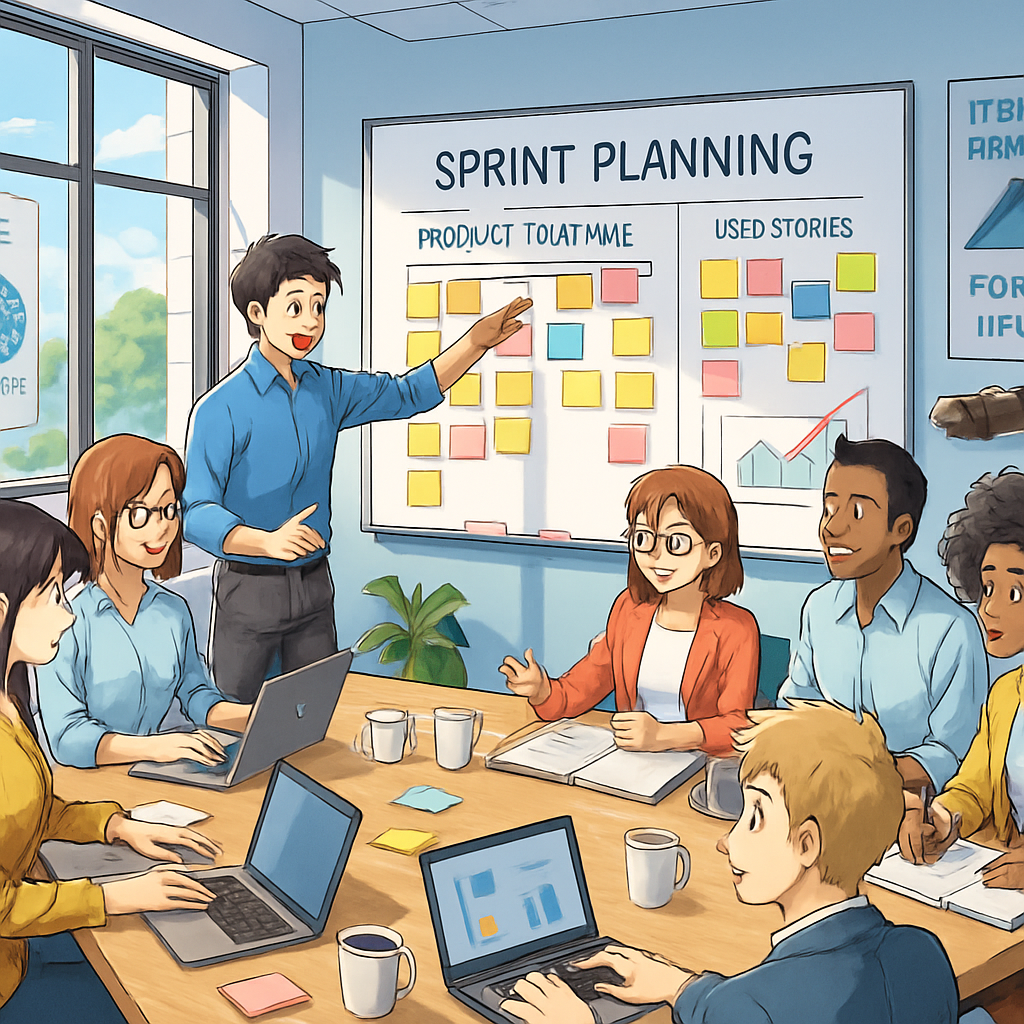
- Sprint Planning: A meeting at the start of the cycle where the team defines what can be delivered and how to achieve it.
- Daily Stand-ups: Short, daily check-ins (usually 15 minutes) for developers to align on progress and flag any obstacles.
- Iterative Development: The ongoing process of building and improving the product based on real-time feedback.
- Sprint Review: A demo session at the end of the sprint where the team presents completed work to stakeholders and customers.
- Sprint Retrospective: A reflection meeting to discuss what went well, what didn’t, and how to improve processes for the next sprint.
- Release Planning: Managing the rollout of new features. Agile encourages frequent releases to gather immediate user data.
- Monitoring and Adaptation: Keeping track of progress and adapting as necessary.
What is a Minimum Viable Product (MVP)?
A Minimum Viable Product (MVP) is an early version of a product with just enough features to satisfy early customers and provide feedback for future development.
- Why use an MVP? It validates your product idea with minimal risk and investment.
- When is it built? Usually within the first few sprints.
- Goal: To learn from actual user behavior rather than assumptions.
How to Measure Progress in Agile
In Agile, the primary measure of progress is working software. However, teams also use specific metrics to track efficiency:
- Velocity: The amount of work a team can successfully complete in a single sprint.
- Burndown/Burnup Charts: Visual tools that show the amount of work completed versus the work remaining.
- Customer Satisfaction: Feedback scores that indicate if the product is meeting user needs.
Common Agile Frameworks Explained
While "Agile" is the philosophy, frameworks are the toolkits used to implement it.
- Scrum: The most popular framework for small teams. It relies on fixed-length sprints and specific roles like the Scrum Master (facilitator) and Product Owner (voice of the customer).
- Kanban: A visual method using boards (Kanban boards) to manage work-in-progress. It focuses on continuous flow rather than fixed sprints.
- Extreme Programming (XP): A framework emphasizing technical excellence, involving practices like pair programming, frequent releases, and constant communication.
- Other Notable Frameworks: Adaptive Project Framework (APF), Dynamic Systems Development Method (DSDM), and Feature Driven Development (FDD).
Real-World Examples of Agile Success
- Cisco: Transitioned its Subscription Billing Platform from Waterfall to Agile.
- Result: Reduced defects by 40% and improved release efficiency. Cisco also leverages cross-functional teams to foster collaboration over command-and-control structures.
- Fitbit: Adopted an incremental Agile approach to scale production.
- Result: Shipped 22 million devices and released four new products within a single year of making the switch.
Conclusion
Adopting Agile practices—from rigorous sprint planning to defining clear user stories—allows organizations to navigate uncertainty and deliver value faster. Whether you choose Scrum, Kanban, or a hybrid approach, the key is to remain flexible, measure your progress with data, and always prioritize the needs of your customer.
Ready to transform your product strategy? Explore our full library of Agile resources to get started.
.png?width=250&height=125&name=extra%20small%20NU%20Horizontal%20Logo%20Purple%20(1).png)