Unlocking Growth, Loyalty, and Profitability Through Superior Service
Introduction
In today’s hyper-competitive marketplace, price and product features are no longer the sole drivers of purchasing decisions. The new battleground is customer experience (CX). But is CX just a buzzword, or does it drive tangible financial results?
The answer is clear: superior CX is a critical engine for growth. It transforms casual buyers into loyal advocates and turns satisfaction into revenue. In this post, we explore the data-backed business value of customer experience and why prioritizing the customer journey is no longer optional—it is a strategic imperative for long-term success.
The Loyalty Premium: A Tale of Two Companies
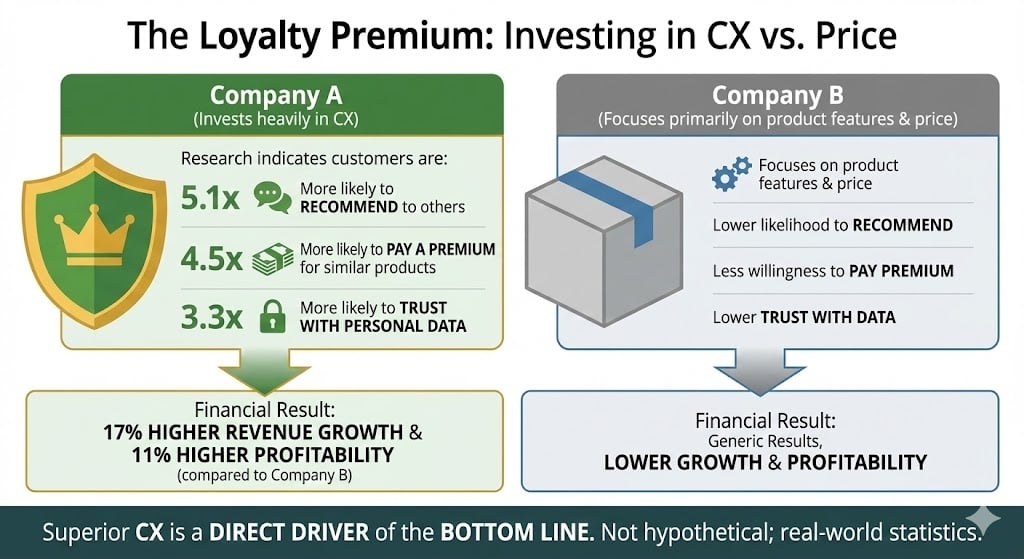
To understand the impact of CX, imagine two competing companies. Company A invests heavily in customer experience, while Company B focuses primarily on product features and price.
The difference in outcomes is staggering. Research indicates that customers of Company A are:
- 5.1 times more likely to recommend the company to others.
- 4.5 times more likely to pay a premium for similar products.
- 3.3 times more likely to trust the company with their personal data.
The financial result? Company A enjoys 17% higher revenue growth and 11% higher profitability than Company B. This isn't hypothetical; these real-world statistics demonstrate that superior CX is a direct driver of the bottom line.
The Strategic Importance of CX
Customer experience has evolved from a "nice-to-have" differentiator to a core business strategy. According to Qualtrics, CX is the impression your customers have of your brand throughout their entire buyer's journey.
Here is how a strategic focus on CX impacts five key areas of business performance:
1. Competitive Differentiation
In markets where products are increasingly commoditized, how customers feel about an interaction often determines who wins the sale.
- Experience Over Price: 64% of people find customer experience more important than price when making a purchase decision.
- Hard to Replicate: While competitors can copy features and lower prices, a company culture deeply integrated with exceptional service—like that of Apple or The Ritz-Carlton—is nearly impossible to duplicate.
2. Customer Retention and Loyalty
It is a well-known fact that acquiring a new customer costs 5–25 times more than retaining an existing one. CX is the most effective tool for closing that gap.
- Profit Multiplier: Increasing customer retention rates by just 5% can increase profits by 25–95%.
- Lifetime Value: Emotional loyalty is powerful. Customers who feel emotionally connected to a brand have a 306% higher lifetime value and stay with the brand for an average of 5.1 years, compared to just 3.4 years for satisfied but unconnected customers.
3. Revenue Growth and Profitability
Leading in CX doesn't just save money on retention; it actively generates new revenue.
- The Experience Dividend: CX leaders outperform laggards in revenue growth by 4–8%.
- Willingness to Pay: 86% of consumers are willing to pay more for a better experience, with many willing to pay a premium of up to 16%.
- ROI of UX: Investments in user experience (UX) yield massive returns. Forrester reports that every dollar invested in UX brings $100 in return—an ROI of 9,900%.
4. Brand Reputation and Word-of-Mouth
In the digital age, your reputation is defined by what customers say about you online.
- The Viral Effect: Customers share positive experiences with an average of 9 people, but they share negative ones with 16 people.
- Trust in Reviews: 91% of consumers trust online reviews as much as personal recommendations, making authentic, positive experiences your most valuable marketing asset.
- Recovery Costs: It takes 12 positive experiences to make up for one unresolved negative experience, making "getting it right the first time" financially vital.
5. Employee Engagement and Productivity
Great CX starts with great employee experience (EX).
- The Engagement Loop: There is a direct correlation between employee engagement and customer satisfaction. Employees who feel valued are 31% more productive and drive 37% higher sales.
- Talent Attraction: Companies with strong employer brands attract 50% more qualified applicants and see 28% lower turnover.
Conclusion
The business case for customer experience is undeniable. From driving revenue growth and reducing churn to building a resilient brand reputation, CX is the lever that moves modern businesses forward.
Organizations that view CX as a strategic asset rather than a cost center are the ones that will thrive in the future. By investing in the systems, culture, and training that support superior experiences, you aren't just making customers happier—you are building a more profitable, sustainable business.
Ready to transform your customer experience strategy? Explore our resources to start your journey today.
.png?width=250&height=125&name=extra%20small%20NU%20Horizontal%20Logo%20Purple%20(1).png)